


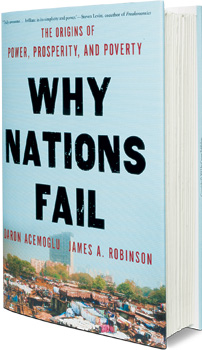
Book Review: Why Nations Fail: The Origins of Power, Prosperity, and Poverty
 Somewhere in Beijing there must be an incinerator for burning reports from outsiders telling China’s leaders what to do. In February the World Bank, in cooperation with an arm of the Chinese government, issued a report called China 2030 that included this gem: “Where contract disputes arise … the disputants should have access not only to legal recourse but also to a transparent and effective judicial system that imparts justice without fear or favor.” It’s hard to imagine President Hu Jintao slapping his forehead in wonderment upon reading this: “But of course! Why didn’t we think of that? Stop the theft of intellectual property at once!”
As silly as it is, the “ignorance hypothesis”—the assumption that people in power would do right by their citizens if only they knew better—“still rules supreme among most economists and in Western policy-making circles,” Massachusetts Institute of Technology economist Daron Acemoglu and Harvard University political scientist James Robinson write in their new book, Why Nations Fail: The Origins of Power, Prosperity, and Poverty. Nations fail, the authors argue, because “those who have power make choices that create poverty. They get it wrong not by mistake or ignorance but on purpose.” For the brutal few, hanging on to power and wealth outweighs all else.
- Published in Culture & Art
- Written by Admin TOA
 By David Swanson - Sibel Edmonds' new book,"Classified Woman: The Sibel Edmonds Story" (352 pages, $21.95 trade paperback, available from Amazon.com in print and Kindle editions) is like an FBI file on the FBI, only without the incompetence. The experiences she recounts resemble K.'s trip to the castle, as told by Franz Kafka, only without the pleasantness and humanity. I've read a million reviews of nonfiction books about our government that referred to them as "page-turners" and "gripping dramas," but I had never read a book that actually fit that description until now.
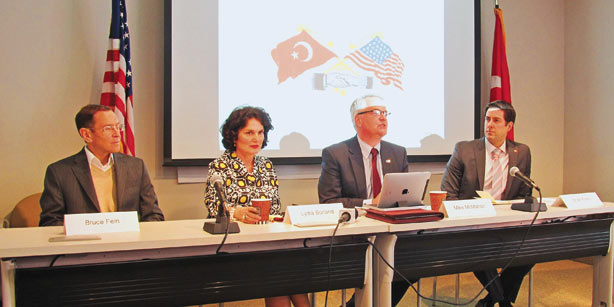 Participants said that Turkish American society needed at least two deputies, one Democrat and one Republican, at the Congress, which would positively affect Turkish-U.S. relations. The 32nd National Turkish-American Congress began in Washington on Thursday.
  By
By  Within 10 minutes of a “Dr. Oz” episode, the phone at Staple & Spice Market in Rapid City often starts ringing. “It is crazy,” said manager Kayla Raterman. “He’s bringing great business our way.” Those phone calls are part of the so-called Oz effect: the reaction people have to the popular CBS medical program, “The Dr. Oz Show.” If Oz recommends it, people tend to buy it.
  The ceremony was attended by Turkish Ambassador, Namık Tan and dignitaries representing the University of Pittsburgh, along with members of Turkish American community in Pittsburgh who contributed to the success of the project through financial contributions and volunteer work.
 If Mehmet Okur was caught by surprise and unsure how to respond to being traded from the Utah Jazz to the Nets, his sister, Seda, had no such ambivalence. “Oh yeah, she was excited,” Okur said today of his sister, who lives in New York City. “When I called her, she couldn’t believe it for like five minutes. She said, ‘Mehmet, I need to call you back. Give me like five minutes. I want to catch my breath!’ “I was like, ‘Take your time. Don’t pass out,’ ” Okur said with a smile. “She was excited.”
  Imagine being thousands of miles from home and starting a new life for yourself ... at age 19. You're about to start a new high-level job training seminar and every time your boss yells at you, you barely understand what he's saying. Welcome to Enes Kanter's world.