

Ottoman Synagogue Money and Jewish Printing in the Ottoman Empire

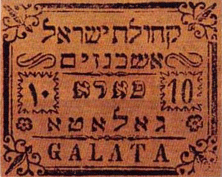
The Money of Ottoman Synagogue, 19th century, Ashkenaz Synagogue (Tunc Buyurgan, Aykiri Paralar)
The use of paper money (Kaime) during the reign of Ottoman Sultan Abdulaziz (1867-1876) was unsuccessful. In the following years, on the eve of the Ottoman-Russian war, the provision of funding requirements made it necessary for Sultan Murat V to attempt to establish its use again. The Sultan announced the Kaime Regulation to restart printing kaime on August 6th, 1877. However, the new Kaimes were not exchanged for gold and silver. The value of the paper currency began to fall and the public lost confidence in using Kaimes.
- Published in Culture & Art
- Written by Admin TOA


How did it begin? On July 15th, at about 10:00 pm, the coup attempt began with shots inside the General Staff complex in Ankara. Shortly after, the Presidential Complex in Ankara came under fire by tanks and helicopters. Meanwhile, it was reported that military forces had closed Istanbul's Bosphorus and Fatih Sultan Mehmet Bridges, and the Ataturk Airport was shut-down. Factions of the Turkish military took control of the state broadcasting agency TRT to officially announce the coup. Prime Minister Binali Yildirim informed the nation that a coup attempt was underway. Addressing the nation via mobile telephone, President Erdogan confirmed the coup and urged people to resist and defend Turkey’s democracy by getting out to streets.