
Lolita Zinke Will Visit Syrian Refugee Camps in Turkey with A Group of People from Diverse Backgrounds

Lolita Zinke who worked closely with President Trump and served as a member of his Hispanic and women’s outreach committee during the 2016 campaign, has been invited by Serdar Kılıç, Turkish Ambassador to the United States in Washington DC, to visit Syrian refugee camps in Turkey. The group of people from diverse backgrounds who are to come together for this visit will have the chance to see what the Turkish government has done about Syrian refugees. Lolita Zinke, better known as Lola, was born and raised in Santa Barbara, California. She graduated from the University of California, Santa Barbara and California Western School of Law. Afterward, she provided bilingual felony arraignment services for the San Diego Public Defenders Office. Lolita lived in Adana in the late 1980s and she fell in love with the culture, food, and people. She married Ryan Zinke, who served as United States Secretary of the Interior in the Trump Administration between 2017 and 2019, until his resignation.

Dauntless Advocate for Ancient Treasures of Anatolia: Larry The Turk

Lawrence Kaye represents a wide range of domestic and international clients in complex litigations and commercial transactions. He also represented the Republic of Turkey in its successful efforts to recover the fabled Lydian Hoard antiquities, long held by the Metropolitan Museum of Art, and some 1,800 ancient Greek and Lycian coins which Connoisseur Magazine called "The Hoard of the Century." Larry talked to TURKOFAMERICA.

Prominent Turkish Historian Kemal Karpat Dies at Age 96

Internationally acclaimed Turkish historian Kemal Karpat died on Feb. 20 in the United States aged 96. Karpat, an expert on the Ottoman Empire and modern Turkish history, was an emeritus professor at the University of Wisconsin-Madison. He had celebrated his 96th birthday on Feb. 15. Professor Karpat taught in Department of History of University of Wisconsin-Madison for 36 years, from 1967 until his retirement in 2003. His research pioneered the study of late Ottoman history, and focused on the rise of ethnic nationalism and Islamic political discourse. He leaves a rich legacy as one of the leading Ottoman historians of his generation.  He also will be remembered for his contributions to the study of Ottoman History in higher education. During his time at UW-Madison, Karpat served as director of the Center for Turkish Studies, and contributed funds to its endowment. Karpat also endowed a professorship in Ottoman and Turkish History, which is currently held by Professor Daniel Stolz.

Tagged under

The Most Well Written Story of Turkish Tea

How did you meet Turkish people and Turkish tea first? Did you know anything about them before then? 
Before coming to Turkey I had little knowledge about the country, its people or customs. I of course knew the basics: that it was a Muslim country located in the Middle East; that the Ottomans ruled there; that it was famous for baths and strong coffee, but that was about it. I had learned, however, much about its art in my university classes. I remember being fascinated as a child by the image of the camel on the pack of Camel cigarettes my father smoked and always asked to play with the pack. I think the first words I ever learned to read were “Turkish Tobacco” which was written in bold on the pack! But I knew nothing about the tea culture: I assumed that all Turks drank Turkish coffee!

Jim Sparks, The Largest North American Representative of Turkish Borates

American Borate Company (ABC) is a privately held corporation headquartered in Virginia Beach, Virginia and the Company has marketed borates from Turkey since 1981. ABC has become the largest North American representative of Turkish borates. Jim Sparks, President of American Borate Company has been traveling to Turkey since 1983 for the borate business initially working with Eti Bank, which is now Eti Maden. Jim purchased an air dunnage bag manufacturing operation in city of Amasya. This operation currently employees over 200 people. Since becoming involved in Turkey, his companies have purchased Turkish produced product worth more than 2 billion dollars.

Jeff Helps Bilkent’s Cyberpark Firms to Open U.S. Market

Jeff Engell, lead consultant of the Bilkent Cyberpark Accelerator Program (CAP), Turkey's first fully international accelerator, which was recognized globally by the International Association of Science Parks (IASP) and a recipient of the Inspiring Solutions Award. Engell became involved with Bilkent’s CAP, which has as one of its goals to connect its companies to strategic partners and customers in the U.S.Bilkent Cyberpark is Turkey’s first private Science and Technology Park (STP) established in 2002 by Bilkent University. The cyberpark is large, with about 240 high-tech companies, eight research centers and more than 3,300 R&D personnel. Innosphere, Colorado based company which supports highly motivated entrepreneurs working on innovations, reached out to Bilkent Cyberpark in Ankara, Turkey in a partnership that could potentially bring Turkish startups – and economic activity -- into Colorado. The idea was developed by Jeff Engell, a former Fort Collins resident who moved to Turkey and saw an opportunity to create a Colorado-Turkey connection. Engell answered TURKOFAMERICA’s questions.

George Schieber Keeps Her Wife Legacy Alive Through A Scholarship

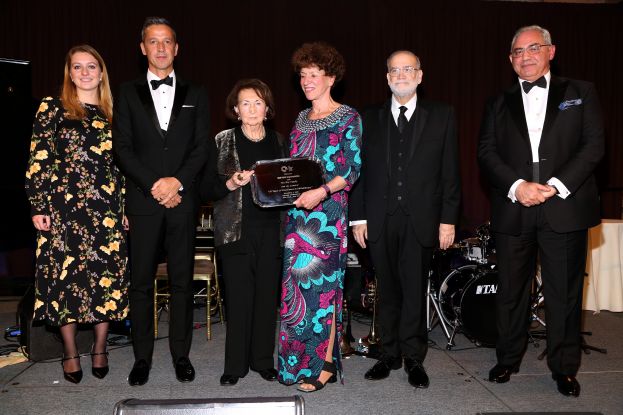
Sena Eken Schieber was a pioneering international civil servant and a role model for many women. After graduating from Robert College in Istanbul and receiving her PhD from Pittsburgh University, she worked at the IMF rising to the rank of Assistant Director, the highest for a Turkish employee in the history of the institution. She died on June 3rd, 2014 in Washington, DC. Her husband, George Schieber established Sena Eken Schieber Economics Award in 2015 with Turkish Philanthropy Funds. His late wife, Sena Eken Schieber’s legacy will now live with the empowerment of talented women from Turkey.

Ed Whitfield: A Strong Voice of Turkish-Americans on Capital Hill

Wayne Edward Whitfield is an American politician who served as the U.S. Representative of Kentucky's 1st congressional district from January 1995, until his resignation in September 2016. As co-founder and co-chair of the Congressional Caucus on U.S.-Turkey Relations and Turkish Americans, he was an ardent supporter of the U.S.-Turkey relationship and a voice on Capitol Hill for Turkish Americans. As the Republican co-chair, Whitfield founded the Turkey Caucus in 2001 along with his Democratic counterpart, former Congressman Robert Wexler of Florida. Their original objective was to have 25 members in the Caucus. The growth of the Caucus, however, exceeded expectations. At the time of Whitfield’s retirement from Congress, Caucus membership was 155, with 43 of the 50 states and all six territories represented. Congressman Whitfield talked to TURKOFAMERICA.

A Cultural Diplomat: Demetra George

Demetra George (Mustafoğlu), Honorary PhD: one of the most celebrated musical ambassadors of the United States. Soprano Demetra George has graced opera stages and concert halls, including Carnegie Hall as well as U.S. Embassies across Europe.  A two-time Grammy List nominee for her cd “Demetra George Sings Love Arias” she has sung for four U.S. Presidents, and performed with over 700 symphony orchestras and boasts a repertoire of more than 20 opera and operetta roles and 18 in musical theater.

Bridging Cultures Through Archaeology: Exploring Ancient Turkey for 40 Years

Charles Brian Rose is an American archaeologist, classical scholar, and author. He is the James B. Pritchard Professor of Archaeology at the University of Pennsylvania in the Classical Studies Department and the Graduate Group in the Art and Archaeology of the Mediterranean World. After graduating from Haverford in 1978, Rose pursued his Ph.D. in Classical Archaeology at Columbia University. Concentrating on the Roman Imperial period, his interests expanded to include the eastern Mediterranean, where he took part in New York University’s excavation at Aphrodisias, Turkey, and the uncovering there of a large and extremely well-preserved early 1st century AD sanctuary dedicated to the Imperial Cult (the cult of the emperors). His thesis, completed in 1987 and published in 1997 by Cambridge University Press, examined the sculpture, coins, and inscriptions associated with the Imperial Cult throughout the Mediterranean world during the period demarked by the life of Julius Caesar (100–44 BC) through to the suicide of Nero in AD 68.

Tagged under
Subscribe to this RSS feed